
Light Requirements
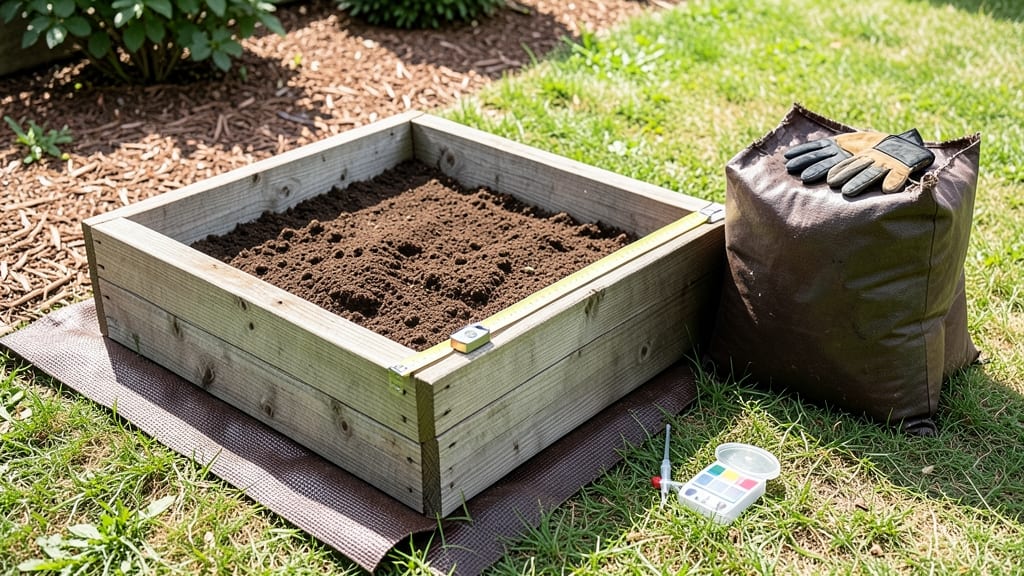
For an 8x4x2 raised garden bed, you'll need approximately 12.8 cubic feet (0.36 cubic meters) of soil—or about 3.6 cubic yards—before accounting for natural settling. To ensure proper drainage and fertility, aim for a blend of 60% topsoil, 30% compost, and 10% perlite/sand, though adjustments may be needed based on your local soil conditions. While pre-mixed raised bed soil is convenient, it often costs more per cubic foot than creating your own custom mix.
Figuring out the exact amount of soil for your raised bed starts with simple math: multiply the length (8 feet), width (4 feet), and height (2 feet) to get 64 cubic feet of raw space.
However, soil naturally compacts by about 20-30% once added, which is why you need more than the bed's visible volume. 🌱 I always recommend buying 20-30% extra soil to account for this settling—it saves last-minute trips to the garden center.
The soil mix ratio isn't just about volume; the right combination prevents waterlogging while keeping nutrients available for plant roots.
If you're looking to save money, consider sourcing materials locally. Many farms sell topsoil in bulk at lower rates than garden centers, and compost can often be obtained for free from municipal programs or local farmers.
For an 8x4x2 bed, you'll need roughly 2.5 cubic yards of topsoil, 1.2 cubic yards of compost, and 0.4 cubic yards of perlite/sand—though exact amounts may vary based on how tightly you pack the soil.
Pre-mixed bags might seem convenient, but they often contain fillers that don't provide the same long-term benefits as a custom blend.
💡 In This Article
- Calculating Soil Volume for an 8x4x2 Raised Bed
- Cost-Saving Soil Mixes for Raised Beds
Calculating soil volume for an 8x4x2 raised bed
The math behind soil volume starts with your bed's dimensions: multiply length (8 feet) by width (4 feet) by height (2 feet) to get 64 cubic feet of raw space. However, this is just the starting point—soil doesn't stay at this volume once added.
When you layer soil into a raised bed, it naturally compacts by 20-30% due to settling and moisture absorption. This means your actual usable volume shrinks to about 48-50 cubic feet after settling, which is why you need to purchase extra soil upfront.
Here's how the numbers break down: Your 8x4x2 bed requires 12.8 cubic feet of soil per inch of height when accounting for compaction. For the full 2-foot height, this translates to 12.8 cubic feet × 2 = 25.6 cubic feet of loose soil needed before settling.
Convert this to cubic yards by dividing by 27 (since 1 cubic yard = 27 cubic feet), giving you roughly 0.95 cubic yards per inch of height or 1.9 cubic yards total for a 2-foot bed.
Most suppliers sell in 0.5 cubic yard increments, so you'd typically purchase 2 cubic yards to account for settling and any minor measurement errors.
The 2-foot depth is critical for root growth—most vegetables need at least 12-18 inches of soil to thrive, while deeper-rooted plants like tomatoes or carrots benefit from the full 2 feet. Shallower beds (6-12 inches) may work for herbs or leafy greens but risk restricting root development.
The extra depth also helps maintain moisture levels during dry spells and reduces competition from surrounding grass or weeds. For custom bed dimensions, simply adjust the formula: (length × width × height) × 1.25 (to account for 20% compaction).
Soil texture plays a hidden role in compaction. Sandy soils settle more dramatically (up to 30%) due to their loose particles, while loamy soils (ideal for raised beds) compact by about 20%. Clay-heavy mixes can actually expand when wet, complicating calculations.
That's why the 60% topsoil, 30% compost, 10% perlite/sand ratio works so well—it creates a balanced texture that minimizes excessive settling while maximizing drainage and aeration. 🌱
Pro tip: If you're building multiple beds, calculate the total volume first to qualify for bulk discounts. For example, two 8x4x2 beds would need 3.8 cubic yards of loose soil, which might save you 15-20% compared to buying smaller bags.
Always measure your soil in loose piles (not packed bags) to avoid overestimating—most suppliers will deliver the exact volume you specify, so accuracy pays off in both cost and convenience.
One common mistake is assuming the bed's visible volume equals the soil needed.
The 2-foot height might look like it holds 64 cubic feet, but after accounting for compaction and the 2-3 inch frame depth (where soil doesn't settle), your actual usable soil is closer to 45-50 cubic feet.
This is why gardeners often end up with leftover soil—it's better to have extra than to run short mid-project. 💫