
Tools
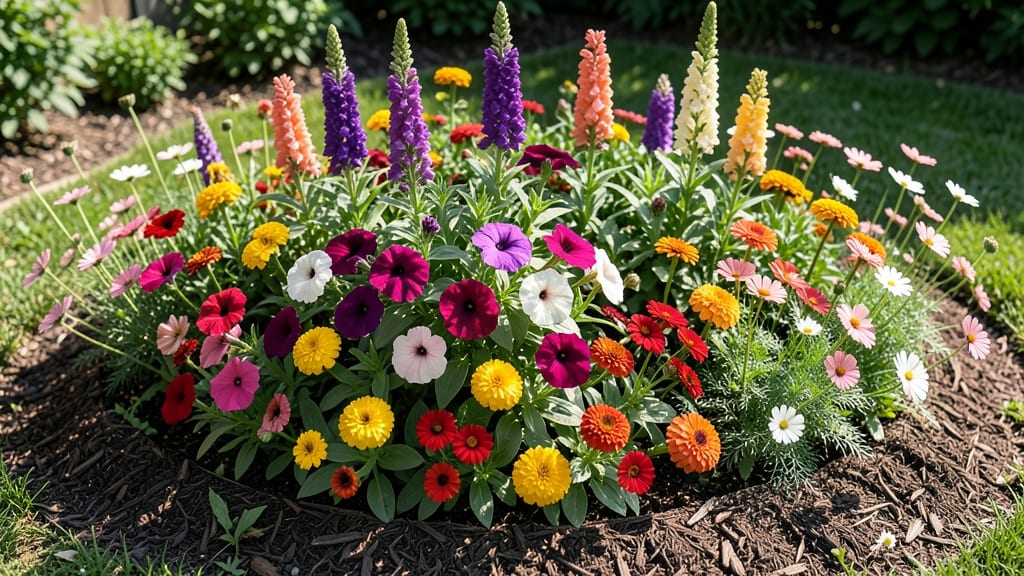
A flower garden in the shape of a circle’s area is calculated using the formula πr², where r is the radius (half the diameter). Multiply the radius by itself, then by 3.1416 (π) to find the square footage for planting and material estimates. Always measure diameter first to determine radius accurately.
A flower garden in the shape of a circle’s area is calculated using the formula πr², where r is the radius (half the diameter).
This formula works because a circle’s circumference relates directly to its radius through π, the constant ratio of a circle’s circumference to its diameter. 🌸 Understanding this helps you plan plant spacing efficiently—especially when designing concentric rings or radial patterns.
For example, a 10-foot diameter garden has a 5-foot radius, so its area is π × 5² = 78.5 square feet, giving you precise measurements for mulch or soil needs.
Beyond just math, circular gardens offer unique design opportunities. You can create visual layers by planting taller flowers near the center and shorter varieties around the edges, maximizing sunlight exposure. This shape also works beautifully with curved pathways or focal points like a fountain.
The key is balancing aesthetics with practical spacing—most perennials need 12-18 inches between plants for healthy growth, while ground covers can fill gaps more densely.
💡 In This Article
- Understanding Circular Garden Area Formula for Plant Layouts
- Designing a Circular Flower Bed: Spacing, Zones, and Plant Selection
Understanding circular garden area formula for plant layouts
The formula πr² works because a circle’s area depends on its radius, not diameter. The radius (r) is simply half the circle’s diameter—so if your garden measures 12 feet across, its radius is 6 feet.
Multiplying the radius by itself (6 × 6 = 36) gives the base area, then multiplying by π (3.1416) converts this into the actual square footage (36 × 3.1416 ≈ 113 square feet).
This precision matters when calculating how many plants or mulch you’ll need—every extra inch of radius adds significantly more space!
Why π? Because it’s the constant ratio of a circle’s circumference to its diameter. Imagine "unfolding" a circle into a rectangle: one side becomes half the circumference (πr), and the other is the radius. The area of this rectangle (πr × r) equals the circle’s area.
This geometric relationship explains why π appears in the formula—it’s not arbitrary!
For example, a 10-foot diameter garden (radius = 5 feet) yields π × 25 ≈ 78.5 square feet, while a 20-foot garden (radius = 10 feet) jumps to π × 100 ≈ 314 square feet—double the area with just double the radius.
Circular gardens often outperform square or rectangular ones for plant spacing. Concentric rings let you group plants by sun exposure or height, creating natural layers. For instance, place sun-loving lavender in the outer ring (where it gets full morning light) and shade-tolerant ferns near the center.
This radial design also maximizes edge space—where most plants thrive—compared to corners in rectangular beds.
The formula helps visualize this: a 15-foot diameter garden (area ≈ 176 square feet) can fit more perimeter plants than a 12×12-foot square garden (area = 144 square feet), even though both have similar total areas.
Practical tip: Use the formula to plan "plant zones." Divide your circle into rings at 2-foot intervals (e.g., 3-foot, 5-foot, 7-foot radii) to create distinct layers.
Each ring’s area (π × radius²) tells you how many plants to allocate—say, 3 daisies per square foot in the outer ring and 1 hosta per square foot near the center. This method ensures even coverage and avoids overcrowding.
For irregular shapes, approximate the circle’s diameter by measuring the longest straight line across the center. If your garden has a slightly off-center focal point (like a tree), adjust the radius to the farthest edge.
For example, a garden with a 14-foot diameter but an 8-foot radius on one side still uses the largest radius (7 feet) for calculations—this ensures you account for all planting space.
Why does this matter? Overestimating area leads to wasted mulch or soil, while underestimating causes gaps. For a 16-foot diameter garden (radius = 8 feet201 square feet), you’d need about 600 cubic feet of soil if digging 3 inches deep—precise planning prevents shortages. 🌿