
Advice
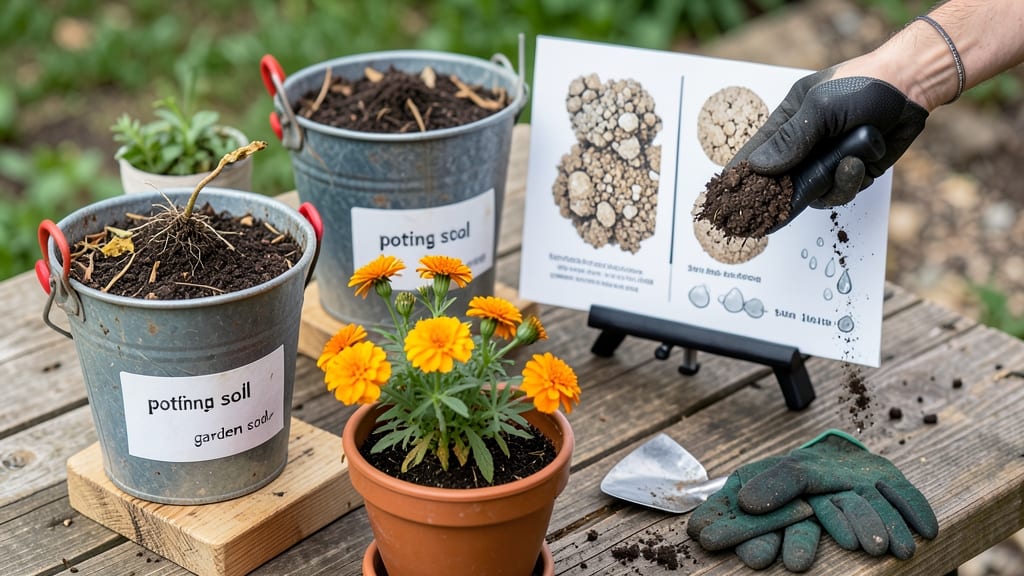
You can't use garden soil as potting soil because it compacts easily, retains too much moisture, and lacks proper drainage—key traits potting mixes need. Instead, blend it with perlite, sand, or compost for better aeration and structure, but avoid heavy clay or sod-heavy dirt entirely.
Garden soil's heavy clay and organic matter create a dense, waterlogged environment that suffocates roots and invites fungal diseases. 🌱 Unlike potting mixes designed with coarse sand or perlite, garden soil lacks the air pockets plants need to breathe.
For container gardening, I recommend mixing garden soil with 20-30% perlite or vermiculite—this improves drainage while keeping nutrients. Even then, it's best reserved for hardy plants like native wildflowers rather than delicate annuals.
For most potted plants, commercial potting mixes are the safest bet because they're formulated to balance moisture retention with aeration.
If you're working with a budget, try combining garden soil with coconut coir or compost in a 2:1 ratio—this mimics the structure of quality potting soil while using what you have on hand.
Just remember: the goal is to mimic the loamy, well-draining conditions plants thrive in, not replicate garden soil's compacted texture.
💡 In This Article
- Why Garden Soil Fails as Potting Mix
- Safe Ways to Mix Garden Soil for Potting
Why garden soil fails as potting mix
The core issue with garden soil is its particle density. Most garden soil contains 40-60% clay or silt, which creates a dense matrix that collapses when watered, eliminating the air pockets roots need.
In contrast, quality potting mixes contain 30-50% coarse sand or perlite to maintain 30-40% porosity—the ideal range for oxygen exchange. Without this structure, roots suffocate, leading to stunted growth or rot within 2-3 weeks of planting.
Moisture retention is another critical failure point. Garden soil holds water like a sponge, often 50-70% moisture capacity when saturated, while potting mixes stay at 20-30% capacity.
This excess water creates anaerobic conditions where roots can't breathe, and harmful microbes thrive. 🌱 The texture difference is dramatic: potting soil feels light and crumbly (like wet sand), while garden soil is heavy and sticky (like wet clay).
This moisture imbalance is why container plants wilt rapidly after watering when planted in garden soil.
Nutrient availability also shifts dramatically. Garden soil's organic matter breaks down slowly, releasing nutrients over months—ideal for in-ground plants. But in containers, this slow release creates a buildup of salts and organic acids that burn delicate roots.
Potting mixes use fast-decomposing materials like peat moss or coconut coir to provide nutrients in sync with plant growth cycles, preventing this imbalance.
Consider the case of petunias: they thrive in potting mixes with 50% perlite and 50% composted bark, but wilt within a week in garden soil because their roots can't access oxygen.
The same happens with herbs like basil—garden soil's density causes root rot, while potting mix keeps them lush and productive. Even heavy feeders like tomatoes need the aeration potting soil provides to support their rapid growth.
One exception is native wildflowers or ground covers, which evolved to tolerate garden soil's conditions. Their deep root systems can penetrate compacted layers, but most container plants lack this adaptation.
The key difference is that potting mixes are engineered to mimic the loamy forest floor texture—light, airy, and nutrient-rich—where most container plants originate.
For visual comparison: hold a handful of each soil. Garden soil sticks together when squeezed (high clay content), while potting mix crumbles apart (high organic matter and grit). This simple test reveals why garden soil fails in containers—it's designed for the ground, not confined spaces where roots can't escape compaction.