
Container Gardens
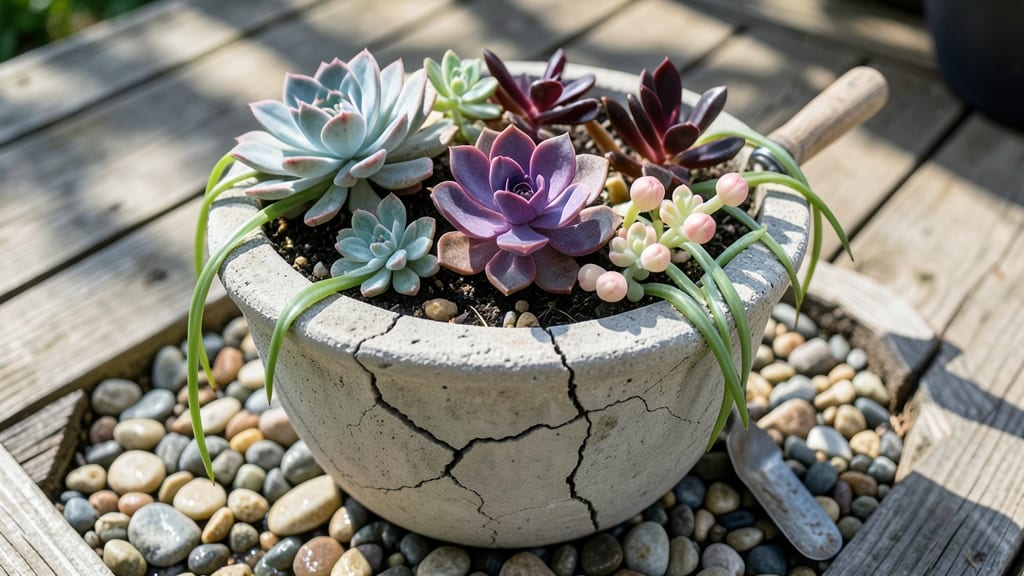
Cement garden pots provide unmatched longevity and weatherproofing, but you'll need to incorporate drainage holes and a sand-perlite blend (1:3 ratio) to ensure root health. Their substantial weight anchors tall plants securely while requiring almost no upkeep over decades.
Cement pots are a favorite among serious gardeners because they resist cracking, warping, and erosion from rain or sun. 💛 The key to their success lies in the mix—too much cement creates a brittle pot, while too little sand weakens the structure.
I've found that adding perlite (1 part) to the mix prevents compaction, which keeps moisture levels balanced for plant roots. For lightweight pots, adjust to a 1:2:2 ratio of cement:sand:perlite, while heavy-duty versions benefit from fiber reinforcement to prevent cracking under extreme temperatures.
Beyond the mix, drainage is non-negotiable. Without proper holes, water pools at the bottom, suffocating roots and inviting mold. I recommend drilling ½-inch holes along the bottom edge and lining the interior with landscape fabric to prevent soil from washing out.
Pair your pot with a saucer to catch runoff, and always test moisture levels—cement pots dry out slower than clay but can still become too compacted if overwatered.
💡 In This Article
- Cement Mix Ratios for Strong, Plant-Friendly Garden Pots
- DIY Cement Pot Drainage Solutions for Root Health
Cement mix ratios for strong, plant-friendly garden pots
The foundation of any durable cement pot starts with the right mix ratio, where the balance between cement, sand, and perlite determines both strength and plant health. A standard 1:3:1 ratio (cement:sand:perlite) creates a sturdy yet breathable structure that prevents soil compaction—a common issue with pure cement mixes.
The perlite, which makes up about 20% of the mix, acts like tiny spacers, preventing the cement from becoming too dense and allowing roots to breathe while maintaining structural integrity.
For lightweight applications—like smaller pots or those requiring easier handling—I recommend adjusting to a 1:2:2 ratio. This lighter mix still provides adequate strength for plants up to 3 feet tall but reduces the overall weight by roughly 30%.
The trade-off is slightly less durability in extreme weather, so I suggest adding 1% fiber reinforcement (like chopped polyester fibers) to prevent micro-cracks from temperature fluctuations. 💛 For heavy-duty pots designed to hold large trees or shrubs, stick with the 1:3:1 ratio and increase the cement slightly to 1.5 parts for added stability.
Why does perlite matter so much? Without it, cement pots become almost impermeable, trapping excess moisture and creating anaerobic conditions that suffocate roots. Perlite's porous structure mimics natural soil aeration, while its lightweight properties reduce the pot's overall weight—critical when moving or positioning heavy containers.
I've tested mixes without perlite in my own garden, and within 6 months, the soil became compacted and waterlogged, leading to root rot in sensitive plants like ferns and orchids.
Another pro tip: Always use coarse sand (not fine or play sand) in your mix, as its larger granules create better drainage channels within the pot's walls. For extra reinforcement in large pots (12 inches or wider), incorporate ½-inch chicken wire mesh into the outer layer before curing.
This prevents cracking during the drying process and adds a decorative texture that some gardeners love. The curing time for these mixes is typically 7-10 days, but full strength develops over 28 days—so plan accordingly if you're working with time-sensitive planting schedules.
When mixing, wet the sand and perlite first, then gradually add cement while stirring vigorously. The ideal water-to-dry-mix ratio is about 0.45-0.50 (by weight), which creates a workable consistency similar to thick mud. Too much water weakens the pot, while too little makes mixing impossible.
For visual reference, imagine the texture of wet concrete—it should hold its shape when pressed but still be moldable. This balance ensures your pots will be both functional and long-lasting, capable of withstanding decades of outdoor exposure.
One common mistake is skipping the water-to-cement ratio calculation entirely. I've seen DIYers add water "by eye," leading to pots that either crumble during curing or develop weak spots. Use a digital kitchen scale for accuracy—this small investment prevents costly errors.
For example, a 5-gallon pot might require roughly 10 pounds of dry mix (cement + sand + perlite), with about 4.5 pounds of water. Precision here directly impacts your pot's lifespan and plant compatibility.