
Light Requirements
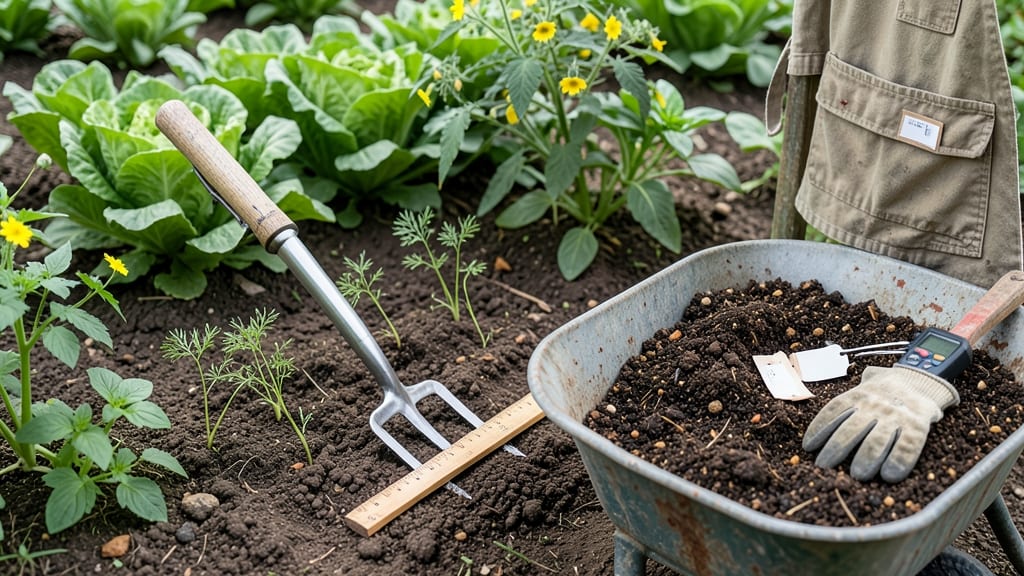
To determine how much compost you need for your garden, calculate 1-3 inches of compost per square foot of garden bed, adjusting for soil quality: sandy soil needs more, while clay soil benefits from less. For a 10x10-foot bed, use 10-30 cubic feet of compost total.
Figuring out compost needs starts with your garden's size and soil type. 🌱 For example, a 5x10-foot vegetable patch would need between 5 and 15 cubic feet of compost, depending on whether your soil is nutrient-poor or already fertile.
The key is balancing organic matter—too little won't improve soil structure, while too much can create compaction. I recommend testing your soil first: if it's heavy clay, aim for the lower end of the range, while sandy soil can handle the full 3 inches per square foot.
Another critical factor is what you're planting. Root vegetables like carrots benefit from deeper compost layers, while leafy greens need lighter applications. For established lawns, spread ¼-inch compost annually—this prevents overloading while gradually enriching the soil.
The best approach? Start with a thin layer, monitor plant health, and adjust next season.
💡 In This Article
- Calculating Compost Needs by Soil Type and Garden Size
- Compost Application Tips for Different Garden Plants
Calculating compost needs by soil type and garden size
Soil composition dramatically alters how much compost your garden truly needs. Sandy soils, with their large particles and poor nutrient retention, often require 2-3 inches per square foot to improve water-holding capacity and microbial activity.
Think of it like adding moisture to a dry sponge—sandy soil simply can't hold onto nutrients without organic matter. In contrast, clay soils, which are dense and compact, typically need only 1 inch because their natural structure already traps moisture and nutrients more effectively.
Loam soils, the happy medium with balanced texture, usually thrive with 1.5-2 inches of compost.
The depth matters just as much as the spread. A 1-inch layer covers about 0.083 cubic feet per square foot, while 3 inches jumps to 0.25 cubic feet per square foot.
For a 10x10-foot garden bed, that means the difference between 8.3 cubic feet (1-inch layer) and 25 cubic feet (3-inch layer). Visualize a 1-cubic-foot bag of compost—you'd need roughly 10 bags for the shallow layer or 25 bags for the deeper application.
This is why gardeners often start with a 2-inch layer as a compromise.
Plant types also influence your calculations. Root crops like carrots and beets benefit from deeper compost layers (2-3 inches) to encourage downward growth, while shallow-rooted plants like lettuce or herbs need only 1 inch.
The science here involves soil aeration: deeper compost loosens compacted layers, allowing roots to penetrate more easily.
For example, a 5x5-foot raised bed planted with carrots might need 12.5 cubic feet of compost (2 inches deep), whereas the same bed for lettuce could use just 6.25 cubic feet (1 inch deep).
Don't overlook the role of existing soil quality. If your garden soil is already rich in organic matter (dark, crumbly, and retains moisture well), you might only need ½ inch of compost annually as maintenance.
However, if your soil is depleted (light-colored, dry, or crumbles easily), start with the full 2-3 inches and monitor plant health. A simple test: squeeze a handful of moist soil—if it holds its shape but crumbles when poked, your soil is ideal.
If it falls apart like dust, it's time for compost!
For precise calculations, multiply your garden's square footage by the desired depth (in feet). For instance, a 6x8-foot bed at 2 inches deep requires 9.6 cubic feet of compost.
Pro tip: Buy compost in bulk (by the cubic yard) if you have large areas—1 cubic yard = 27 cubic feet, enough for a 13.5x13.5-foot bed at 2 inches deep. This bulk approach saves money and reduces waste from partial bags.
Seasonal timing also plays a role. Spring is ideal for deep applications (2-3 inches) to prepare soil before planting, while fall's 1-inch top-dressing helps overwintering plants and soil microbes.
The key is consistency—over-applying compost can create anaerobic pockets (smelly, waterlogged soil), while under-applying leaves nutrients lacking. Start conservatively, observe plant growth, and adjust next season.