
Tools
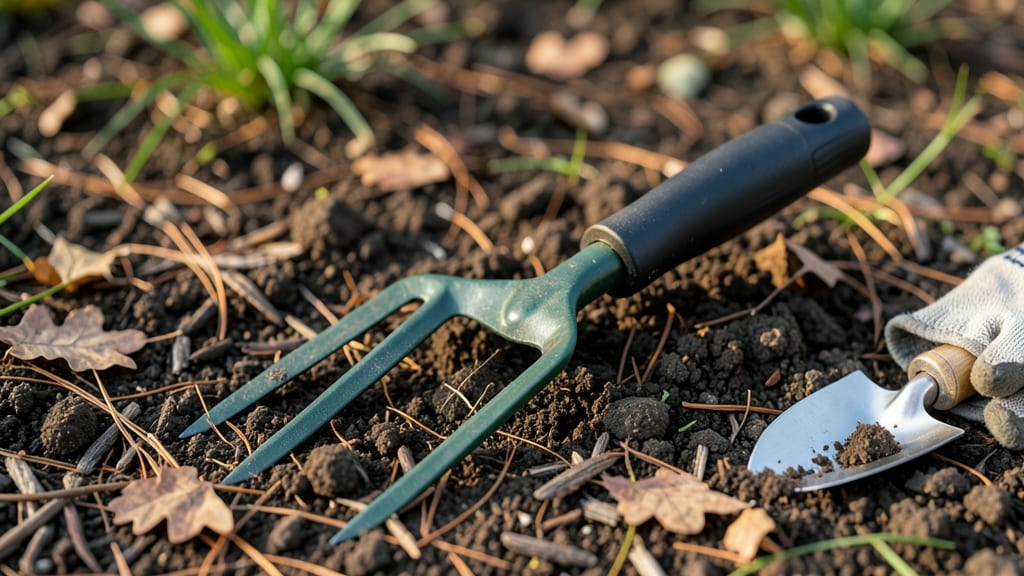
A three-pronged gardening tool is perfect for loosening compacted soil, uprooting stubborn weeds, and aerating garden beds by driving its tines deep and twisting them free. Work in dry soil to prevent clumping and never overwork the same spot to avoid creating hardpan.
A three-pronged gardening tool works like a soil surgeon, slicing through roots and breaking up compacted earth without disturbing nearby plants. 🌱 The prongs grip weeds at their base, making it easier to pull them out completely—unlike hand-weeding, which often leaves fragments behind.
For rocky soil, angle the tool slightly to avoid damaging the prongs while still lifting weeds effectively. I've found pairing it with a hoe creates a one-two punch: use the hoe for surface weeds and the three-pronged tool for deep-rooted invaders.
This tool shines in vegetable gardens where precision matters, but it's also great for flower beds and lawn edges. The key is patience—work in small sections and rotate the tool's position to prevent soil compaction. For best results, use it when soil is dry enough to crumble but not powdery.
💡 In This Article
- How a Three-Pronged Weeder Works for Deep Soil Aeration
- Best Techniques for Using a Three-Pronged Tool in Different Gardens
How a three-pronged weeder works for deep soil aeration
The three-pronged gardening tool operates like a precision soil scalpel, designed to penetrate 3-5 inches deep into the earth with minimal surface disturbance. Each prong typically measures 1/4 to 3/8 inch in diameter, creating a triangular formation that mimics natural root channels.
When you press down and twist, the prongs cut through weed roots while simultaneously breaking up compacted soil layers—something hand-pulling simply can't match. The twisting motion creates a corkscrew effect that grips roots firmly, preventing them from snapping off at the surface like they often do with hand tools.
What makes this tool superior for stubborn weeds is its ability to target the root crown—the thickest part of the weed system where most regrowth occurs.
For example, dandelions and quackgrass have deep taproots that can extend 12-18 inches below the surface, but the three-pronged weeder can still access the upper root zones where hand tools fail.
The prongs' sharp edges create clean cuts that minimize soil disturbance, unlike broad hoes that can churn up weeds and spread their seeds. This precision is why professional gardeners often call it the "weed surgeon's tool." 🌱
The tool's design also addresses soil compaction by creating micro-channels that improve water and air penetration. When you work the prongs in a grid pattern (every 6-8 inches), you're essentially building a network of drainage paths without disturbing plant roots.
The key is to avoid overworking the same spot—repeated pressure can create hardpan. For rocky soil, tilt the tool slightly to navigate stones while maintaining leverage. The prongs' triangular shape allows them to wedge between rocks without dulling quickly, unlike flat-edged tools that can chip.
Here's what's happening at the molecular level: As you twist, the prongs compress soil particles around the weed roots, creating localized pressure that severs connections between root cells and soil nutrients. This is why weeds often come out whole rather than breaking off.
The tool's weight distribution (typically 2-4 pounds) provides enough force for deep penetration without requiring excessive user strength. For comparison, a standard hand weeder requires 15-25 pounds of pulling force—something that becomes exhausting over large garden areas.
For maximum effectiveness, use the tool when soil moisture is at 30-40% saturation—dry enough to crumble but moist enough to hold shape. In these conditions, the prongs glide through soil rather than pushing against it.
Wet soil (>50% saturation) causes clumping that can dull the prongs and make weeding less efficient. The tool's ergonomic handle (usually 12-18 inches long) allows for proper leverage, reducing wrist strain during long sessions. This is particularly valuable for gardeners with arthritis or limited hand strength.
Consider this real-world example: In a 4' x 8' vegetable bed, using a three-pronged weeder takes about 10-15 minutes to clear stubborn weeds like lamb's quarters, compared to 30-45 minutes with hand-pulling.
The tool's efficiency comes from its ability to target multiple weeds simultaneously while aerating the soil—a dual-purpose that saves both time and effort. For flower beds with delicate perennials, the tool's precision allows weeding within 2 inches of plant bases without damaging roots.