
Planting
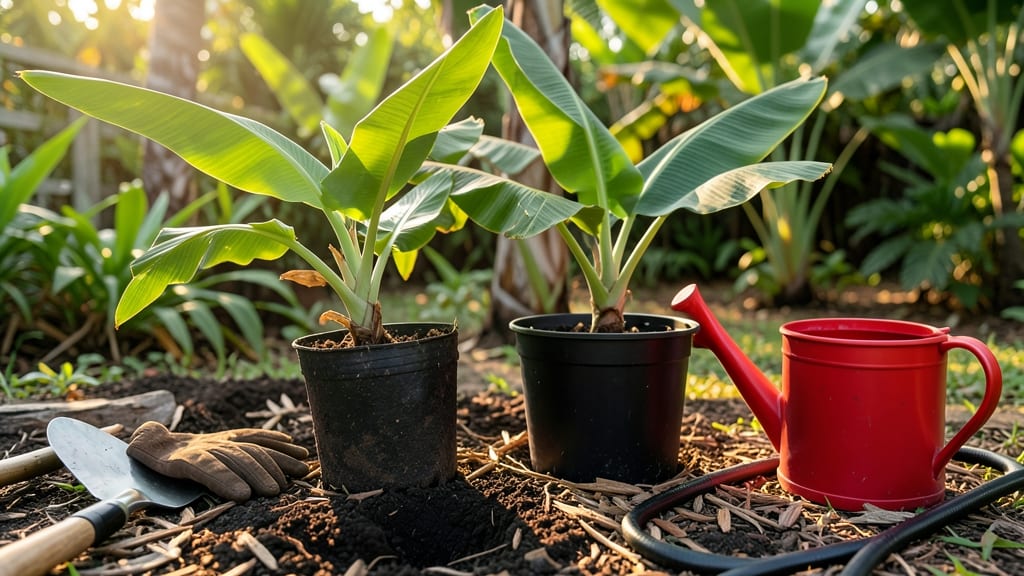
What happens if you plant bananas in your garden? They’ll grow as striking tropical foliage plants with bold leaves and thick pseudostems, but they’ll only produce fruit if planted in warm USDA Zones 10–11. These plants make excellent ornamentals and often bounce back from frost damage using their underground rhizomes.
Banana plants are non-hardy tropicals that focus their energy on dramatic foliage rather than fruit in cooler climates. 🌿 The pseudostem (what looks like a trunk) is actually tightly packed leaves—when you see new leaves unfurling, that’s the plant’s growth phase.
Even in colder zones, they’ll regrow from the rhizome after frost kills the top growth, making them surprisingly resilient for a tropical plant.
What’s fascinating is how they flower: the massive inflorescence emerges from the center of the plant, eventually bearing fruit only in warm conditions. Without those ideal temperatures, the plant redirects energy to leaf production, creating those iconic banana-shaped leaves that gardeners love for their tropical vibe.
Beyond aesthetics, banana plants can also serve practical purposes like windbreaks or privacy screens due to their rapid growth and large leaves. Many gardeners propagate new plants from the suckers (offshoots) that form at the base, ensuring a steady supply of ornamental foliage even if fruiting isn’t possible.
💡 In This Article
- Banana Plant Growth Stages and Hardiness Zones
- Creative Ways to Use Banana Plants in Landscaping
Banana plant growth stages and hardiness zones
The banana plant's growth begins with the rhizome, an underground stem that produces the first leaves through a process called monocarpic growth.
This means the plant focuses all its energy on producing leaves and a pseudostem (the false trunk made of tightly wrapped leaf bases) for about 9-18 months before flowering.
During this phase, you'll see new leaves unfurl every 2-4 weeks, each reaching 6-10 feet long—these leaves are some of the largest in the plant kingdom, with a waxy texture that repels rain.
What's remarkable is how the pseudostem develops: it's not wood but layers of leaf sheaths that provide structural support. The plant's hardiness comes from this rhizome system, which can survive temperatures down to 28°F for short periods.
However, once the plant flowers (visible as a massive inflorescence emerging from the center), it redirects energy to fruit production.
In colder zones outside USDA 10-11, this flowering stage fails, and the plant's energy returns to leaf production—explaining why you often see banana plants with no fruit in temperate gardens.
The key to understanding hardiness zones lies in the plant's photoperiod sensitivity. Banana plants native to tropical regions need 12+ hours of daylight to trigger flowering. In northern climates with shorter days, this signal never occurs, so the plant remains in vegetative growth.
Even in Zone 9, where winters are mild, banana plants may survive but rarely fruit because the photoperiod remains insufficient. 🌱 This is why gardeners in cooler areas focus on banana plants as foliage specimens rather than fruit producers.
Here's what happens when temperatures drop: the pseudostem and leaves die back at 28°F or below, but the rhizome often survives. What's fascinating is how the plant regenerates—new shoots emerge from the rhizome within 2-4 weeks of warming temperatures, sometimes producing multiple new pseudostems.
This resilience makes banana plants excellent candidates for seasonal interest gardens, where they provide dramatic foliage in summer and regrow in spring.
For those in Zones 10-11, the growth cycle continues differently: after fruiting, the original pseudostem dies completely (the plant is monocarpic), but the rhizome produces suckers (offshoots) that can be separated and replanted.
This perpetual cycle explains why tropical banana plantations can produce fruit continuously—each new sucker becomes the next fruiting plant. In colder zones, this cycle is interrupted, but the ornamental value remains high.
Consider this comparison: a banana plant in Zone 11 may reach 12-15 feet tall and produce fruit within 9-12 months, while the same plant in Zone 8 will focus entirely on leaf production, reaching 8-10 feet with no fruiting.
The difference isn't just about temperature but about the plant's biological response to daylight and seasonal cues—a perfect example of how environment shapes plant behavior.